The Scenes of Political Fashion
- Kiran Molloy
- Nov 10, 2021
- 6 min read

Updated: Mar 8, 2023
Introduction
Fashion is more than the clothes you wear. As Kelebogile Motswatswa says:
“There is a socio-political discourse around fashion and dress, particularly where Africa is concerned. Dress transcends mere global trends, and there is more to it than meets the fashionable eye; it is a language of self-expression and a tool of both denigration and resistance.”
Fashion as self-expression is key here, and in today’s world - so strongly informed by social media - we see clothes used to more than just dressing the body. It is through fashion that ideas of identity, sexuality, gender, body ideals and luxury lifestyle are shaped.
Fashion has a longstanding relationship with identity as it forms a fundamental part of self-expression.The politics of fashion are thus ultimately politics of identity. Who we are, what we identify with, and how our environments affect us are articulated through dress. Clothing can be used to express a multitude of identities such as race, gender, class, nationality, and of course sexuality.
Fashion has also long been a mode for underrepresented groups to express themselves and identify each other in public, or in traditionally unsafe spaces. For example, in the 19th century Oscar Wilde sported a green carnation to identify himself as queer, a symbol recently used by Elliot Page at the Met gala, encouraging other queer men to do the same. These signifiers of safety are deeply important, for the representation of marginalised identities, among constant threats of unfair incarceration, violence, and worse, death.
How fashion is tied to society and culture:
Fashion, society and culture are interwoven. This is because our expressions of identity are shaped by social dynamics and norms. Our surroundings influence us. We use clothing to indicate who we are, and who we are depends on our environments and relationships.
As individuals, we are constantly using other people, interests, hobbies, and ideas as reference points. We draw on our social and cultural backdrops to work out our place in society and to understand the world. This allows us to define who we are, distinguish ourselves from others, and to form connections.
In this way, we are tied to our families, the people we grew up with, to our homes and communities. Our sense of self is woven into heritage, social status, religion, and culture. We build our identities from these foundations and the interplay between ideas, knowledge and discourse that operate within these realms.
Fashion and aesthetics like any other art form reflect society, we use clothing to express social aspiration, power struggle, and ideology as this is part of who we are. It becomes easy to see how politics plays into this. Power relationships and politics form the foundation of society. They are, so to speak, our bread and butter, our little black dresses, and casual white T’s.
The dynamics present in society are reflected in fashion. For instance, this can be seen in fashion’s response to COVID-19, including debates around the safety of the vaccination.
Vaccinated fashion
From vaccine lanyards, ready-to-wear garments able to hold vaccine cards, and shirts signifying the wearer’s vaccination status, fashion is once again used to express the thoughts and ideas of the wearer. A specific shirt comes to mind here. It reads: “Trans-vaccinated: I am not actually vaccinated, but I identify as someone who is vaccinated.”
In a few words, this shirt does so much harm through its casual transphobia. To compare lying about being vaccinated to being transgender trivialises both the vaccination process and trans identities. It diminishes the effort of those willing to take the vaccine to protect themselves while bolstering the rhetoric that trans people are actually not the gender they identify as. This message has that familiar transphobic tone that LGBTIAQ+ people have heard too often: “You aren’t really queer, or a woman, or a man, but you think you are.”
Even further, this messaging turns being vaccinated into an identity, rather than a personal health practice, and thus essentialises that process equating it to gender identity.
Being vaccinated is not a fundamental part of one’s being; it is a choice, one we ideally make for our own health and the health of those around us. However we cannot choose which gender we will feel most comfortable with. Comparing this to being transgender is devaluing queer life - a slippery slope leading nowhere good.
This is one example of how power plays a role in fashion and how ideas can be passed and reinforced by the clothes we wear.
Fashion can also challenge ideas that exist in society. For instance, not only what clothing we wear but whose clothing we wear.
Decolonising South African Fashion
In South Africa the representation and relevance of local designers is often overshadowed by Eurocentric ideals that not only colonised our land but also our fashion culture. The majority of our popular commercial clothing brands include American, Australian and European franchises such as H&M, Zara, Cotton On and Factorie. However, this is not due to lack of effort.
A common criticism received by African designers is that their collections are not Afrocentric enough. In response Laduma Ngxokolo’s Maxhosa’s Summer 2017 Collection, Apropriyeyshin, aims to address the ways in which African fashion can positively use western fashion ideals while simultaneously representing a sophisticated Xhosa aesthetic. His collection consists of classic western shorts, sweatshirts, jerseys and button shirts, adorned in vibrant traditional Xhosa patterning.

Maxhosa aims to incorporate traditional Xhosa symbolic patterns, beading and colouring into contemporary fashion, to be used in everyday life and for Xhosa initiates (amakrwala).
His collections such as Summer 2020’s SiziiKumnkani NeeKumnkanikazi / WE ARE KINGS AND QUEENS aim to retrieve African peoples pride and value in themselves and their cultures, while continuing with Maxhosa motives to makes these traditional fashions appreciated and normalised.
Local designer, Thebe Magugu has been creating collection after collection addressing current issues of corruption, gender based violence and the decolonisation of South African through fashion.

His Autumn/Winter collection of 2018 “Home Economics” addresses the ongoing battle in SA with Gender Based Violence and misogyny, as he curated a collection of clothing using colour palettes associated with the societal expectation of women as homemakers and the accompanying pastels of cleaning products. Additionally, this collection displayed his critically acclaimed dress “Girl Seeks Girl” depicting a woman comforting another woman, encouraging solidarity in this struggle.
His most recent Summer collection for 2022 “Doublethink” is conceptually based on supporting the efforts of whistleblowers in the country. With western vigilante-inspired suits and pops of colour from the national flag the collection attempts to portray them as brave and motivated individuals who deserve societal, institutional, and legislated support among the pandemic of corruption present in South Africa government and organisations.

As a self-proclaimed “anti-fashion” designer, Marianne Fessler approaches the fashion industry without complying with the fast fashion and temperamental trends that often define it, in favour of sustainability and timeless design. Inspired by her country and continent, she has been a voice for South African culture since 1976, incorporating black models and Afrocentric design in her fashion shows during a time when it was considered rebellion and activism.
Throughout her career she has represented every facet of South Africa’s diverse cultures, with bold colours and patterning, design styles that range from idealistically western to eastern, yet all showcase an authentic African ethos and textiles, consisting of layers of various printed fabrics and textures.
Finally Rich Mnisi developed his brand in 2015 with the intention of creating fashion that tells the diverse tales of South African people from their various cultural backgrounds, unique heritage and perspectives. Using bold but simplistic design the brand curates its designs with elements of film, music, art, and the natural environment of South Africa, while simultaneously pushing the stereotypical boundaries of gender norms and promoting queer representation, through their collections and the groups of young innovators and models the brand collaborates with.
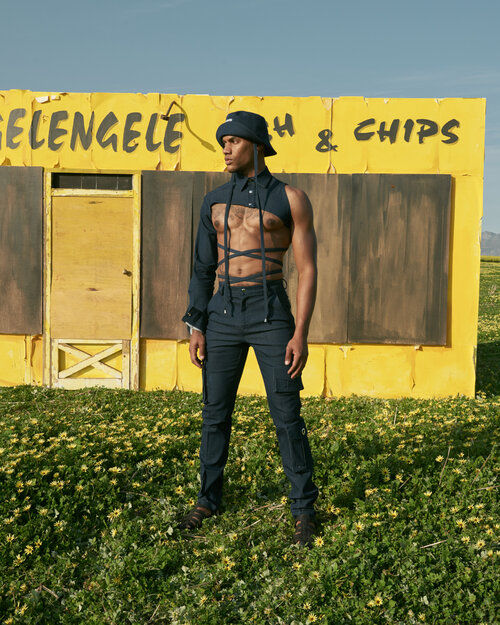
These trends indicate that fashion may become more overtly political. Many designers use clothing and style to shine a spotlight on political issues. In many senses politics is ‘on trend’. In our current climate we see individuals using everyday dress to express their views and political outlook. Purposefully dressing in codified styles, wearing shirts with political statements, or using specific colours to call attention to social issues.
Whether it’s Elliot Page sporting a green carnation in homage to Oscar Wilde (in representation of marginalised identities) or the use of fashion’s prolific audience to present ideas varying from transphobic - miseducation, to activism against current issues such as GBV and corruption - fashion is a medium through which we see the incorporation of diverse, contemporary South African identities.


Comments